My First Hacktoberfest: How I Reached the Top 500 (Completionist++)
Reflections on my very first Hacktoberfest: building 3 open-source AI projects with Google Gemma and TabPFN, reaching Milestone 4 (top ~0.45%), and key lessons learned.
On this page
October has come to an end, and with it, my very first Hacktoberfest!
If you had told me a year ago, when I was just trying to learn about open source community and engage in it, that I would participate in Hacktoberfest, build three open-source AI applications from scratch, and end up among the top ~514 global finishers (Milestone 4: Completionist++) out of 115,000+ registered participants, I probably wouldn’t have believed you.
As I researched, I found that hacktoberfest 2026 was also quite different from previous years. Instead of just counting pull requests across random repositories, MLH, DEV, and DigitalOcean pivoted the event toward hands on open-source AI and community participation. Each week presented fresh challenges designed to push developers to explore open weight models (like Google Gemma and Prior Labs TabPFN, that I used in my projects), join technical livestreams, live events and community discussions on discord, and build genuine, practical tools.
The theme of Hacktoberfest 2026 was AI belongs to everyone, and focused on hands-on learning and building with open-source AI.
Here is the story of how my first Hacktoberfest unfolded, what I built, and the biggest lessons I took away from the journey.
The Turning Point: Aiming for One, Finishing All Four
When Hacktoberfest kicked off in early October, my initial goal was humble: participate in at least one weekly challenge and understand how to run open-weight AI models locally.
I did not have lots of experience working with open weight models, but I was familiar with the concept. So, the live streams were pretty fun for me.
As the weeks progressed, the momentum took over. One project led to another, each challenge pushing me outside my comfort zone. By the end of the month, I had cleared every milestone:
- 🎒 Milestone 1 (Pack): Collect 3 stickers, it qualifies you to get physical stickers at your address.
- ⚙️ Milestone 2 (Complete): Collect 10 stickers, it gets you a special holographic sticker in addition.
- 🏅 Milestone 3 (Completionist): Collect 15 stickers, and you get a Completionist badge and certificate, plus an entry into raffle for a Hacktoberfest 2026 T-shirt or an Arduino Uno Q board.
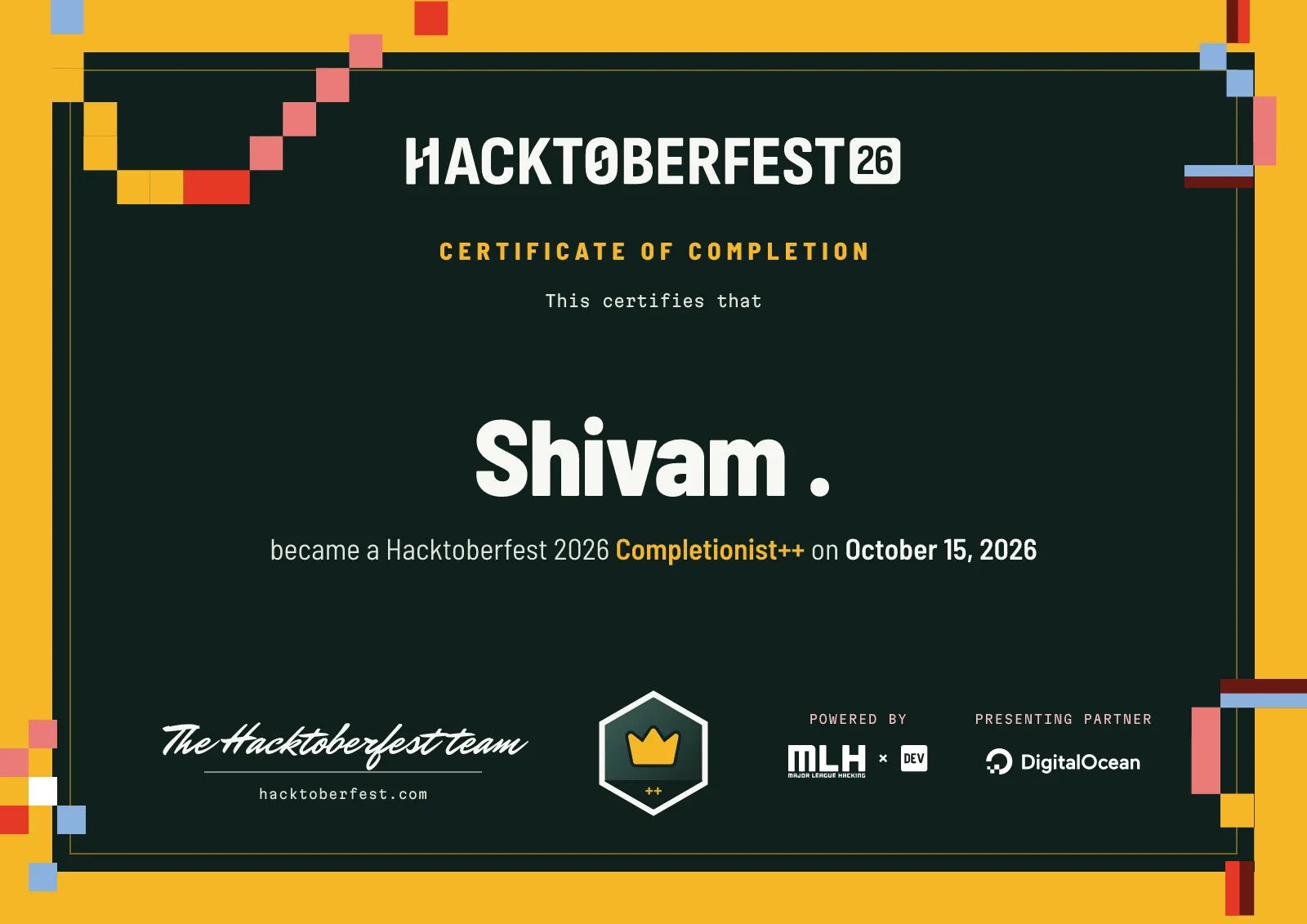
- 🏆 Milestone 4 (Completionist++): Collect at least 20 stickers, it unlocked the final milestone tier, placing in the top ~514 participants worldwide (top ~0.45%) out of 115k registered participants.
Receiving the Completionist++ certificate was an incredible milestone, but the real reward was the code written, the problems tackled, and the community conversations and interaction along the way.
By the way, the stickers can be collected in various way. From regularly watching live streams, submitting weekly projects, some event specific, etcetera.
Here’s my sticker book.
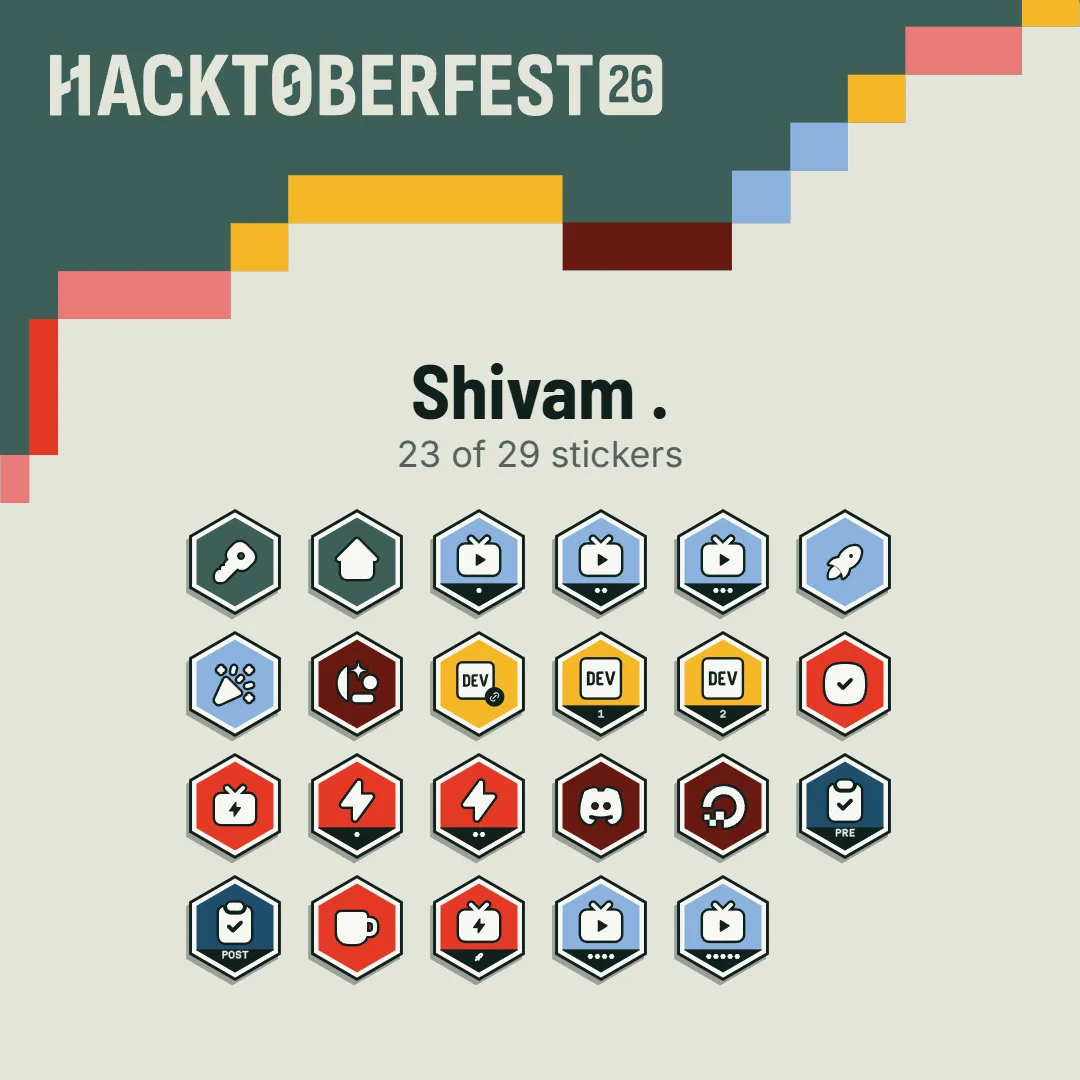
Initially, organizers only told us about the Milestone 3. The 4th milestone was not supposed to be there.
In mid October, some people after reaching, disclosed that there is a 4th hidden milestone, Completionist++. Duing one of the live streams, the main host Jacklyn Biggin said that they don’t know about a 4th milestone, but there can be certain unknown threshold to unlock that.
This was pretty cool like a hidden chest in an RPG game, waiting to be unlocked as we clear new levels.
What I Built During Hacktoberfest 2026
Across the month October, I built and published three distinct open-source projects, all centered around a core belief: AI should be local-first, privacy-respecting, and practical.
1. TerraGemma — Backcountry Expedition Companion (Week 1: “Touch Grass”)
- Theme: Week 1 Challenge — Touch Grass
- GitHub: shivamgravity/terragemma
- Read the Article: TerraGemma on DEV
Most outdoor trail apps have a paradoxical design: they encourage you to stare down at a glowing screen while hiking through scenic wilderness. Even worse, the moment you lose cell service, closed-cloud AI models (like ChatGPT or Claude) turn into dead loading spinners.
I built TerraGemma with a strict design philosophy: “Eyes Up, Screen Down.”
- Offline Edge AI: Powered by Google Gemma 3 (1B and 4B) served locally via Ollama. It generates concise sensory navigation anchors (e.g., “Listen for the feeder stream at mile 0.8; feel the wind shift from the western valley as you exit the treeline”).
- Audio Briefing & Pocket Phone: Uses browser-native Web Speech API to read the briefing aloud at the trailhead so you can stow your phone away.
- Deterministic NOAA Solar & Naismith Engine: Calculates astronomical sunsets and safe turnaround deadlines incorporating elevation gain penalties, with zero cloud dependencies.
- Offline First Responder (WFR) Triage: Provides calm, step-by-step wilderness emergency guidance even in complete airplane mode.
2. PhyInvoice AI — Freelance Billing & Revenue Defense (Week 2: “Side Hustle”)
- Theme: Week 2 Challenge — Side Hustle
- GitHub: shivamgravity/phyinvoice-ai
- Live Demo: phyinvoice-ai.onrender.com
- Read the Article: PhyInvoice AI on DEV
Freelancers and solo contractors routinely lose 15% to 20% of billable earnings because of messy time notes, unbilled micro-tasks, and unspoken scope creep. Furthermore, uploading proprietary client code or tickets to third-party commercial LLM clouds violates client NDAs.
PhyInvoice AI solves this with a two-model hybrid architecture:
- Google Gemma (Local Ollama): Turns informal 3-word developer notes (e.g., “debugging jwt auth”) into polished, dispute-proof deliverable sentences ready for clients.
- Prior Labs TabPFN-3.5: A tabular foundation model that analyzes historical session duration variance, off-hours spikes, and task divergence to predict scope creep and budget leaks before they occur.
- Deterministic Agency Math: Strictly splits math from LLM inference—enforcing standard tenth-hour (
6-minute) and quarter-hour (15-minute) rounding rules.
3. Dadi’s Rasoi — AI Family Recipe Cookbook (Weekend Challenge: “Build for a Friend”)
- Theme: Weekend Challenge — Build for a Friend
- GitHub: shivamgravity/hf26-recipe-archived
- Demo App: archive-recipe.streamlit.app
- Read the Article: Dadi’s Rasoi on DEV
Like many families, our traditional recipes exist in someone’s memory or scattered across WhatsApp voice notes.
I built Dadi’s Rasoi (Grandma’s Kitchen) for my grandmother and family:
- Private Audio Transcription: Uses
faster-whisper(int8 quantized) running directly on the CPU to transcribe authentic Hindi and Hinglish speech notes without cloud uploads. - Structured JSON Extraction: Gemma 3 (4B) extracts ingredients, step-by-step instructions, and preserves personal phrasing (like “namak apne hisaab se” / salt to taste).
- Local SQLite Storage: Saves recipe cards privately on the laptop so cherished family memories stay within the family.
There are many great projects made by others during this period. You can go to dev.to and search hacktoberfest, you will see the winners projects. Some are really down to earth and simple problems but the solution made is really remarkable.
These are the challenges for this year’s hacktoberfest and their winners project.
- Weekend Challenge: Build For A Friend
- Week 1 Challenge: Touch Grass
- Week 2 Challenge: Side Hustle
- Week 3 Challenge: Slow & Steady
- Week 4 Challenge: Ghost In The Machine
These projects are really interesing with real world use case, build by real people.
4 Big Lessons from My 1st Hacktoberfest
Looking back at the intense month of shipping code, here are the core lessons that stood out:
1. Open-Weight Models Give You Superpowers
Before this hackathon, like many developers, my instinct for AI was to reach for an API key. But running models like Google Gemma Series and Prior Labs TabPFN locally via Ollama changed my perspective entirely:
- $0 in API Bills: You can iterate, test edge cases, and run thousands of prompts without watching a billing meter tick upward.
- Privacy by Default: Family voice recordings and sensitive client billing data never leave your local machine.
- Offline Resilience: When your app works in airplane mode on a mountain trail, it can work anywhere.
But, to run fairly good models locally - you will need good RAM like over 16 GB or better to have a 32 GB. I currently have 8 GB RAM in my laptop, so I am using quanitized models, which work pretty good but it takes a lot of time to run even a 4 billion parameter model. So, using the quantized version for now.
If you have 16 GB or 32 GB RAM, you are at a pretty sweet spot. You can run quite a lot of models locally and even bigger models with their quantized versions.
2. Never Let an LLM Do Arithmetic
One of the most important architectural patterns I implemented in PhyInvoice AI was keeping AI and arithmetic strictly decoupled. LLMs are extraordinary at understanding context, nuanced phrasing, and synthesis, but they should never calculate dollar totals, taxes, or 6-minute billing increments. Let deterministic TypeScript or Python code handle math, and let the model handle language.
3. Build What Actually Solves a Personal Problem
It is tempting in hackathons to chase trendy buzzwords. But the projects that resonated most with the community—and were the most fun to build—were grounded in personal problems:
- Wanting to disconnect while hiking safely (TerraGemma).
- Protecting freelance income against unbilled micro-tasks (PhyInvoice AI).
- Preserving a grandmother’s cooking legacy (Dadi’s Rasoi).
When you build for an authentic use case, the feature set clarifies itself naturally.
4. Consistency Trumps Perfection
When looking at hackathon leaderboards or milestone tiers, it is easy to feel imposter syndrome. But Hacktoberfest is an endurance run. Breaking down goals week by week, attending community discussions, documenting each build transparently on DEV, and shipping functional code was what made reaching Milestone 4 possible.
Wrapping Up
My first Hacktoberfest was an unforgettable learning curve. It challenged me to level up my understanding of edge AI, tabular foundation models, local-first web architecture, and community collaboration.
A huge thank you to the organizers at MLH, DEV, and DigitalOcean, as well as the sponsors and community mentors who hosted livestreams and reviewed entries throughout October.
If you are thinking about participating in open source or entering your first hackathon: don’t wait until you feel 100% ready. Pick a small problem, open your editor, and start building.
You can explore all my project repositories on GitHub, check out my full articles on DEV, and view the interactive project modal directly on my Projects Page.
Happy Hacking!
Enjoyed this article?
Tap the clap button to show your appreciation!
Questions, thoughts, or ideas? Share below — no account required.
No comments yet
Have a question or feedback? Be the first to start the discussion!
Delete comment?
Are you sure you want to delete this comment? Its content will be permanently removed.